How Much Money Do You Need to Vacation in Switzerland?
For a comfortable summer Switzerland trip like ours, I would budget about $3,900 to $4,000 per adult before personal shopping. That includes long-haul flights from California, lodging, Swiss trains and passes, groceries, restaurants, and normal trip extras.
The important part is not that your trip will match our number exactly. It probably will not. The useful lesson is where the money actually went: flights and lodging did most of the damage, food was closer to $400 per adult once we corrected for restaurant meals paid by someone else, and the rail-pass decision was worth doing carefully instead of guessing.
We planned this as a family-style trip, not a backpacker trip and not a luxury itinerary. We moved between a few classic Switzerland stops, spent meaningful time in the mountains, mixed apartments with hotels, and tried to spend money where Switzerland actually felt special instead of letting every category run wild.
If you like seeing trip budgets broken into real categories instead of vague daily averages, this is the same method I used in my Iceland trip cost guide. The destination is different, but the planning principle is the same: separate fixed costs from flexible ones, then focus on the choices that actually move the total.
Quick answer: what our Switzerland trip cost
Our real-world benchmark came out to roughly $3,900 to $4,000 per adult before personal shopping.
That number includes:
- long-haul flight costs from California
- lodging across the trip
- Swiss trains, local transport, mountain transport, and passes
- groceries, restaurants, and snacks
- normal activity and travel extras
It does not include personal shopping, souvenirs, or every tiny one-off purchase. I am leaving those out on purpose because they make the article less useful. When you are planning your own Switzerland budget, the big decision is not whether someone bought an extra sweatshirt or snack. It is whether your flights, lodging, rail pass, mountain days, and food strategy make sense together.
The trip assumptions that matter
Use our number as a benchmark if your trip looks broadly similar to this:
- you are flying from the West Coast or another long-haul U.S. origin
- you are staying around 10 to 12 nights
- you want a comfortable, scenic trip rather than the cheapest possible version
- you plan to use Swiss trains and mountain transport instead of renting a car for everything
- you are open to apartment stays, groceries, and selective restaurant meals
If you are traveling in shoulder season, using simpler lodging, or skipping expensive mountain rides, your trip can come in lower. If you book late, stay in premium hotels, eat out constantly, or add multiple big alpine excursions, it can climb quickly.
I would treat this as a practical planning range, not a universal rule. Airfare, lodging, exchange rates, and pass prices move, so re-price the major pieces before you book.
Our cost breakdown, simplified
Here is the cleaner way to think about the budget:
| Category | What to know | Our rough per-adult benchmark |
|---|---|---|
| Flights from California | One of the two biggest cost drivers | About $1,300+ |
| Lodging | The other major driver, especially in scenic areas | About $1,600+ |
| Swiss transport and passes | Trains, local transit, mountain transport, and pass costs | About $525 |
| Food and groceries | Still manageable with apartment stays, but not tiny | About $400 |
| Activities and extras | Depends heavily on how many paid mountain add-ons you choose | Low-to-moderate for us |
The biggest planning takeaway: flights plus lodging were about three-quarters of our adult baseline.
That is why I would not start a Switzerland budget by obsessing over coffee prices. Start with the big levers:
- when you fly
- where you stay
- how many times you move bases
- whether you book apartments or only hotels
- how many mountain rides you plan
- which rail pass, if any, actually fits your route
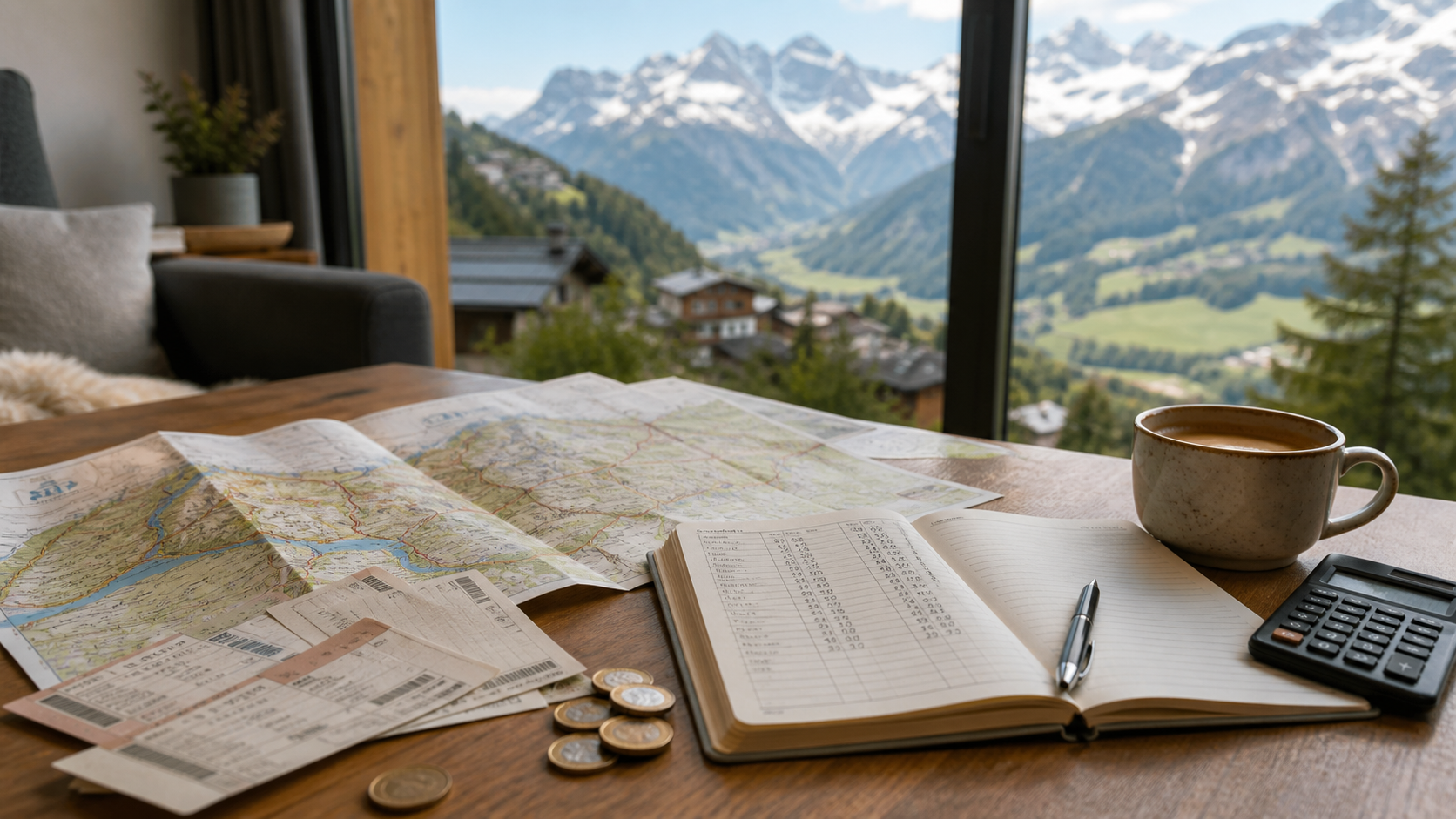
A Switzerland trip budget gets much easier to manage once you separate fixed costs from optional splurges.
What made Switzerland expensive for us
Flights from California were a major fixed cost
Coming from California gave the trip a different budget shape than a short European hop. Before we bought a single train ticket or paid for a meal, airfare had already created a big baseline.
That does not mean you should avoid Switzerland from the West Coast. It just means flight timing matters. A better fare can save more than a week of tiny food optimizations.
Lodging mattered more than almost anything else
Lodging was the other big driver. Switzerland rewards you for staying somewhere beautiful, but that is also exactly what you are paying for.
For us, the mountain portion was worth it. Waking up close to the scenery changed the feel of the trip. But if I were trying to lower the budget, lodging is one of the first places I would pressure-test: fewer bases, more apartment-style stays, or slightly less famous locations can all move the total.
Mountain transport adds up fast
Normal Swiss trains are not the whole problem. The expensive part is when you start stacking scenic railways, gondolas, cable cars, and special mountain excursions.
That is why Switzerland pass advice gets confusing. The right answer depends less on “Switzerland is expensive” and more on which mountains and routes you are actually paying for.
What was cheaper than expected
Food needed an upward correction from my first pass. Some restaurant meals were paid by someone else, so our own card charges made the food line look lower than it really was. A more realistic planning number for us is closer to $400 per adult.
That still did not wreck the trip. Apartment-style stays, grocery breakfasts, simple lunches, and a few selective meals out kept food from becoming one of the scary categories.
That is the food strategy I would use again: save on routine meals, then spend where the experience actually matters. I would rather buy groceries for breakfast and put the money toward a train view, a mountain day, or a better base.
Was the Swiss Half Fare Card worth it?
For our trip, yes. Our best-value choice was the Swiss Half Fare Card plus buying the actual tickets we needed.
We compared three broad options before and during the trip:
- Swiss Half Fare Card + pay-as-you-go tickets
- Swiss Travel Pass for convenience
- Jungfrau Travel Pass or a mountain-region pass layered into the plan
The verdict for us: the Half Fare Card won.
Our Swiss transport came out to about $525 per adult including the Half Fare Card itself. A comparable Swiss Travel Pass would have cost more for our route, and it still would not have magically covered every expensive mountain ride. The Jungfrau-style pass only started to make sense if we were going to stack several big mountain transport days in that region. For what we actually did, it did not beat the simpler Half Fare approach.
That does not mean the Half Fare Card is always the right answer.
I would frame it this way:
| Pass option | When it can make sense | Our verdict |
|---|---|---|
| Swiss Half Fare Card | You want discounts, but you are willing to buy tickets as you go | Best fit for us |
| Swiss Travel Pass | You are moving constantly and value convenience over exact math | Convenient, but likely more expensive for our route |
| Jungfrau Travel Pass | You are doing several covered Jungfrau-region rides in a tight window | Not worth it for our actual ride mix |
The safest rule is this: do not buy a rail pass because the internet says everyone does. Price your actual route.
For us, the Half Fare Card was worth the extra planning because we had a mix of city transfers, mountain-area travel, and selective bigger rides. If your trip is more train-heavy across the whole country, the Swiss Travel Pass may be worth paying extra for simplicity. If your trip is intensely focused on the Jungfrau region, then a Jungfrau pass deserves a fresh comparison.
What to budget for your own Switzerland trip
For a 10- to 12-night Switzerland trip, I would think in three rough bands:
| Trip style | Rough per-adult budget | What that usually means |
|---|---|---|
| Lower-spend | $2,700-$3,300 | Better flight deal, simpler lodging, groceries, fewer mountain splurges |
| Realistic mid-range | $3,500-$4,500 | Similar comfort level to ours, scenic lodging, mixed food strategy, selective mountain transport |
| Higher-spend | $5,000+ | Peak-season flights, premium hotels, more mountain lifts, more restaurants, less pass discipline |
If you are traveling with kids, your math may change in both directions. Swiss public transport can be surprisingly family-friendly, especially for younger children under current Swiss rules, but flights, lodging layout, and mountain tickets can still keep the total high.
If you want to compare route styles, my 7-day Iceland itinerary under $2,000 is a good reminder that destination alone does not decide the budget. Route design does.
Switzerland trip cost estimator
If you want to pressure-test your own assumptions, use this quick estimator. It is not a booking engine. It is just a fast way to see which category is going to dominate your budget.
Switzerland Trip Cost Estimator
Adjust the biggest budget levers: flights, lodging, pass style, food style, and mountain extras. Kids under 16 can sometimes ride Swiss public transport free with a parent, but flights and some mountain tickets still add cost, so this tool keeps those lines separate.
This is a planning shortcut, not an exact quote. Re-check flights, lodging, and official pass prices before you book.
If you would rather skip the widget, here is the non-interactive shortcut:
| Category | Lower-spend | Realistic | Higher-spend |
|---|---|---|---|
| Flights per adult | $900 | $1,200 | $1,700+ |
| Lodging per adult | $1,000 | $1,500 | $2,300+ |
| Swiss transport per adult | $350 | $525 | $750+ |
| Food per adult | $200 | $400 | $700+ |
| Activities / mountain extras per adult | $100 | $250 | $700+ |
How to do Switzerland for less
If your goal is to keep Switzerland expensive but still sane, these are the levers I would focus on first:
1. Get the flight timing right
Coming from California, airfare was too large to ignore. Flexible dates, shoulder season, and earlier fare tracking can matter more than small daily savings once you are on the ground.
2. Use apartment stays on purpose
This was one of the biggest wins in our trip math. Apartment-style lodging gave us better flexibility, kept breakfast and snack costs low, and made it easier not to treat every meal like an event.
3. Do the rail-pass math before buying anything
This was the most important planning decision after flights and lodging. Compare the Swiss Half Fare Card, Swiss Travel Pass, and any regional mountain pass against your actual itinerary. Do not compare them in the abstract.
4. Be selective with mountain days
One or two big alpine transport days can be worth every dollar. Five or six “while we’re here” add-ons can quietly destroy the budget.
5. Buy the boring gear before you leave
A universal plug adapter, a small luggage scale, and a reusable water bottle are much cheaper to buy before the trip than at airports or resort towns. Those are tiny savings compared with flights, but they are easy wins.
FAQ
How much money do you need to vacation in Switzerland?
For a comfortable 10- to 12-night trip from the U.S., I would plan around $3,500 to $4,500 per adult. Our own California-to-Switzerland trip landed around $3,900 to $4,000 per adult before personal shopping.
Is Switzerland expensive for a family vacation?
Yes, but not always for the reasons people expect. Lodging, flight timing, and mountain transport usually matter more than everyday food. Families can sometimes catch a break on Swiss public transport for younger kids, but Switzerland still tends to land above many other Europe itineraries.
Is the Swiss Half Fare Card worth it?
It was worth it for us. The Half Fare Card plus pay-as-you-go tickets beat the Swiss Travel Pass and Jungfrau-style pass math for our actual route. For a different itinerary, especially one with nonstop national rail travel or several Jungfrau-region rides, I would run the numbers again.
Is the Swiss Travel Pass worth it?
It can be, especially if you want convenience and plan to move around Switzerland frequently. For us, it looked more expensive than the Half Fare Card approach, and convenience alone was not worth the extra cost.
How much should I budget per day in Switzerland?
As a rough non-flight planning shortcut, I would start around $250 to $375 per adult per day including lodging and ground costs for a comfortable trip, then adjust for lodging level and mountain excursions.
What costs the most in Switzerland: hotels, trains, or food?
For us, lodging and flights were the biggest categories by far. Swiss transport mattered, especially for mountain days. Food was still controllable, but the more realistic number was closer to $400 per adult after accounting for restaurant meals paid by someone else.
Final take
If you want the short version, budget around $3,900 to $4,000 per adult for a comfortable Switzerland trip like ours from California, then move the number up or down based on your flights, lodging tier, and mountain plans.
The biggest lesson was not “Switzerland is impossible.” It was that Switzerland is expensive in predictable places. Get the flights and lodging right, use groceries where they make sense, and run the rail-pass comparison before you buy. For us, that meant choosing the Swiss Half Fare Card instead of the Swiss Travel Pass or Jungfrau pass.
If you want more practical money and travel breakdowns like this, start with the best guides hub here.